Breakdown after buying a second-hand boat: who is liable?
Buying a second-hand boat: what happens if a mechanical or electrical problem occurs after the sale?
Buying a used boat is often an exciting project.
But sometimes, a few days or a few weeks after delivery, a serious problem occurs: an engine breaks down, a reverser fails, the alternator is out of order, there is an electronic fault, the bow thruster is inoperative...
In these situations, the same questions always come up:
Who is responsible? Who must pay for repairs? What remedies are available?
French law provides precise, but very different answers based on three essential criteria:
✔️ the status of the seller (private individual or professional)
✔️ whether or not a prior expert appraisal has been carried out
✔️ the exact nature of the fault
I. Buying from a private individual: the fundamental principle of the absence of hidden defects
When the sale is between private individuals, the legal regime is strict.
Contrary to popular belief, the private seller does not guarantee that the boat will work properly. They only guarantee one thing: the absence of hidden defects.
🔹 «The seller only guarantees the absence of hidden defects»: what it really means
When a purchase is made between private individuals, French law lays down a fundamental principle:
👉 the seller does not guarantee the proper operation of the boat
👉 it only guarantees the absence of hidden defects
In other words, a private individual does not undertake to sell a perfect boat, or even one in good mechanical condition.
It only undertakes not to sell a boat with a serious, invisible defect that existed prior to the sale.
This principle follows directly from Article 1641 of the Civil Code :
«The seller is liable for any hidden defects in the goods sold that render them unfit for their intended use, or that impair that use to such an extent that the buyer would not have purchased them, or would have paid a lower price for them, had he or she been aware of them.»
In practical terms, this means that the private seller :
✔️ is not responsible for normal wear and tear
✔️ is not responsible for unforeseeable breakdowns
✔️ is not liable for any apparent defect
✔️ is not liable for a problem that appears after the sale, unless it already existed and met the criteria for a hidden defect.
In other words, the seller :
✔️ does not guarantee the absence of future failures
✔️ does not guarantee the longevity of parts
✔️ does not guarantee perfect mechanical condition
It only guarantees that, at the time of sale, the boat was not affected by a serious, hidden and prior defect.
II. The four mandatory conditions for a latent defect
For the private seller to be held liable, the defect must meet four cumulative conditions:
👉 be hidden (not visible at the time of purchase)
👉 predate the sale
👉 be serious (rendering the boat unfit for use or dangerous)
👉 not be the result of normal wear and tear
If only one of these conditions is missing, there is legally no hidden defect, and therefore no liability on the part of the seller.
III. Part worn by age but working at the time of purchase: private seller not liable
This is the most frequent case after a sale between private individuals: an old part works perfectly when tested, then breaks a few weeks later.
Legal principle
A breakdown due to the natural obsolescence of a part does not constitute a hidden defect.
The seller does not guarantee the future life of mechanical components.
A concrete example
A buyer acquires a boat fitted with diesel engines that are 18 years old and 1,400 hours old. The tests are normal.
Three weeks later, an injector broke... Repairs: €4,500.😟
The expert report concludes that :
✔️ the part was badly worn
✔️ the break-up is unpredictable
✔️ no prior definite defect is demonstrated
👉 There are no hidden defects.
👉 The seller is not liable.
👉 The buyer alone pays for repairs.
IV. Buying with or without an expert appraisal between private individuals
Purchase with appraisal
The defects mentioned in the report can no longer be held against the seller. Only totally undetectable defects remain open to challenge.
Purchase without expert appraisal
The burden of proof rests entirely with the buyer. A judicial assessment is almost always necessary.
Action period: 2 years from discovery of the defect (article 1648 of the French Civil Code).
The major advantage of a marine survey prior to purchase
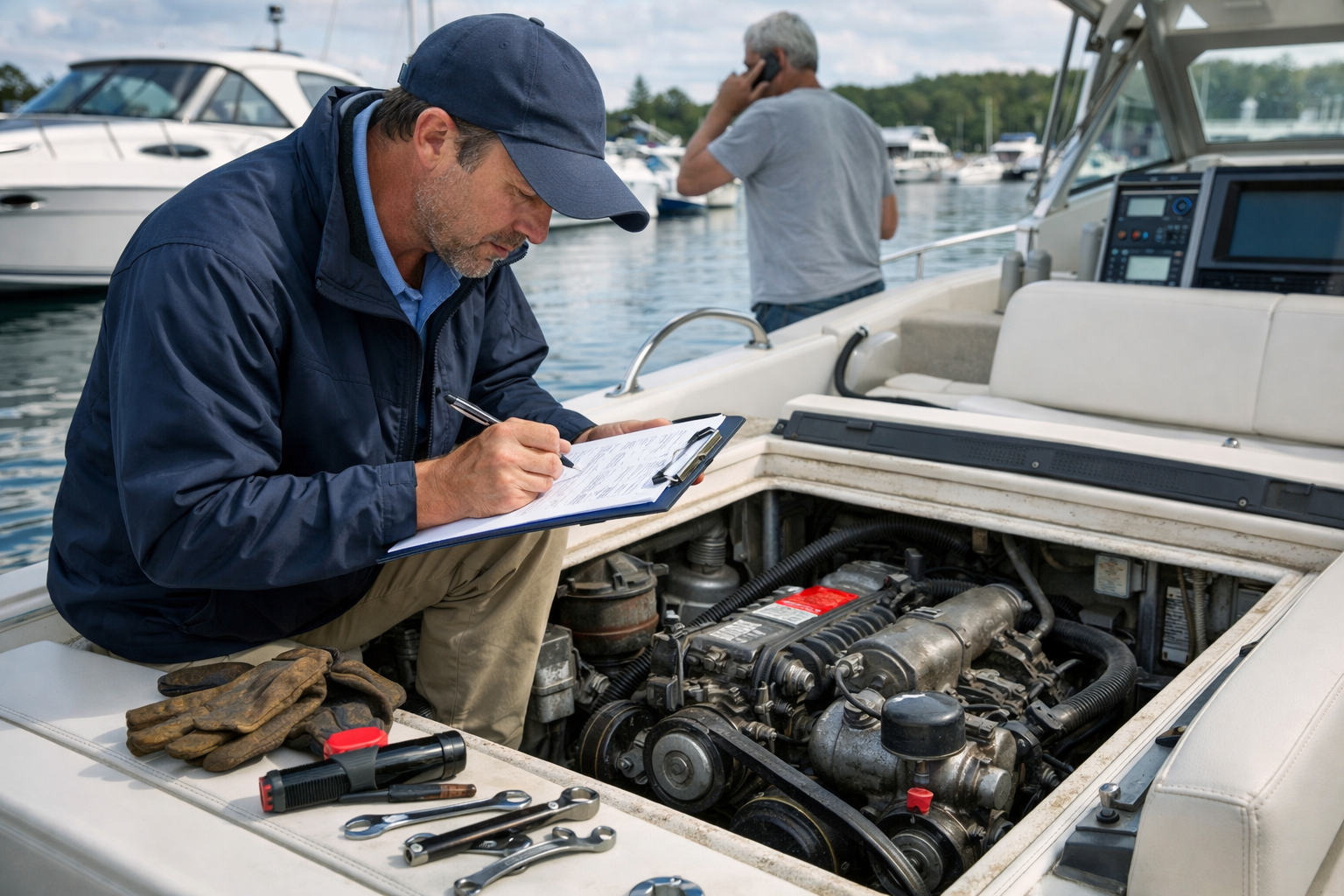
Calling in a marine surveyor before you buy is one of the best investments you can make.
The survey provides an objective and independent snapshot of the boat's actual condition, from a mechanical, electrical and structural point of view. It identifies existing defects, advanced wear and tear, hidden anomalies and work to be carried out in the short or medium term.
It provides legal certainty for the transaction by establishing an enforceable written report, which fixes the condition of the boat on the day of sale and greatly reduces the risk of subsequent disputes.
In financial terms, it is also a powerful negotiating tool, often helping to avoid costly surprises.
Finally, in the event of a dispute, the expert's report is decisive technical evidence.
V. Buying from a professional: greater protection for the buyer
When the seller is a professional (broker, yard, dealer), two warranties automatically apply:
✔️ the legal guarantee of conformity
✔️ the guarantee against hidden defects
The scheme is much more favourable to the buyer.
VI. Parts worn by age that break after purchase from a professional
An old piece broke a few weeks after purchase, even though it was in perfect working order at the time of sale. Who is responsible?
Short answer
👉 In most cases, the professional seller is liable and must pay.
It's not an opinion. It's the law.
🔹 Fundamental principle: the legal guarantee of conformity
When you buy a boat from a professional, you automatically benefit from the legal guarantee of conformity.
(Consumer Code, articles L.217-3 et seq.).
From Order no. 2021-1247 of 29 September 2021, for used goods:
👉 for 12 months after the sale
👉 any defect is presumed to exist at the time of sale, even if it appears later
During these 12 months :
👉 it is not for the buyer to prove the defect
👉 it is up to the seller to prove an external cause
🔹 Wear and tear due to age is not sufficient to exonerate the seller
A wearing part can be sold, but it must have a reasonable life after the sale.
A part that breaks a few weeks after purchase is considered not to be in conformity with normal and durable use, unless clear information is provided in advance.
A typical example
A private individual buys a boat from a professional broker, fitted with diesel engines that are 15 years old and 1,200 hours old. Perfect tests.
Six weeks later, alternator out of order. Bill: €2,800 😞
👉 Applicable guarantee of conformity.
👉 The seller is liable unless proven otherwise.
Cases in which the professional vendor may be exempted
The seller can only avoid paying if he can prove :
✔️ clear information before the sale («end-of-life part»)
✔️ fault on the part of the buyer
✔️ an external cause (shock, power surge, immersion)
✔️ normal wear and tear after a long period of use
But when the breakdown occurs a few weeks after the sale, the seller is, in practice, almost always liable.
🔎 Legal sources:
Consumer Code, article L.217-3
Consumer Code, article L.217-7
Order no. 2021-1247 of 29 September 2021
Cass. civ. 1re, 4 February 2016, no. 14-29612
Cass. com. 15 June 2022, no. 21-10224
IX. Conclusion - The broker's advice
French law makes a very clear distinction between situations:
⚠️ between private individuals, the buyer bears most of the mechanical risk
⚠️ Confronted with a professional seller, the law strongly protects the buyer
In all cases, a preliminary survey is the best way to secure a transaction and limit unpleasant surprises after delivery.
However, there is a new and interesting alternative to a full appraisal:
the pre-sale diagnosis carried out by an approved marine surveyor. bateau-bilan.com
Less costly than an in-depth survey, this diagnosis enables essential aesthetic, mechanical and electrical points to be visually checked, visible faults, advanced wear and immediate risks to be identified, while providing independent technical advice in the form of an official report.
It is often an excellent compromise between safety, budget control and speed of implementation.
Our experience shows that, in the vast majority of transactions, sellers act in good faith.
It should always be borne in mind that the’you buy a second-hand boat that has already sailed and has a certain history.
The breakdowns that occur after the sale are most often the natural consequence of the boat's age, the gradual wear and tear of the equipment or unforeseeable technical hazards.
Before considering legal proceedings, which are long, costly and always uncertain, it is always preferable to give priority to dialogue and the search for an amicable solution.
An open and constructive discussion often leads to a balanced agreement that is quicker and more satisfactory for both parties.