Anchoring and mooring
Anchoring and mooring: the basics for a peaceful night's sleep at anchor
A good anchor is never based on a single piece of equipment. It's always a balance between the anchor, the chain, the windlass and the way you use them. Here's a complete, clear and practical guide to keeping your boat safe both at anchor and in port.
Anchoring and mooring: the basics for a peaceful night's sleep at anchor
When a boat is sailing, you always accept a certain amount of unpredictability. But when it's stationary, everything has to be perfectly under control.
The wrong mooring or an ill-prepared mooring can turn a quiet evening into a sleepless night watching the GPS... or worse, a slow drift towards the neighbour's boat.
At RivieraBroker, we regularly see boats that are very well equipped, sometimes even top of the range, but with a poorly chosen or badly used mooring system. However, a few simple rules are all it takes to make the situation seriously safe.
Here are the key points you need to know.
A good anchorage is a balance
Anchoring a boat is more than just dropping an anchor in the water.
An effective mooring system is always based on a coherent whole made up of several elements:
- The anchor
- The chain
- The mooring line
- The windlass
- And of course the way in which all this is used
If just one of these elements is undersized or ill-suited to the boat, the overall efficiency of the system rapidly diminishes. It is often in these situations that we see a boat start to plough gently along the bottom before drifting away.
A good anchorage is above all a balanced combination of equipment and method.
Choosing the right anchor
The choice of anchor depends mainly on the type of seabed on which you usually anchor.
In the Mediterranean, the seabed is generally :
- Sand
- Vase
- Posidonia seagrass beds
- Mixed sand and rock seabed
On sand or mud, anchors that can be buried deep give excellent results. Models such as ploughs and shovels are still safe bet and widely used.
On mixed bottoms, modern anchors with self-orienting geometry are often more effective. They are able to reposition themselves quickly when the direction of pull changes under the effect of wind or current.
Over the last fifteen years or so, several new-generation models have become established. Their concave shape makes them easy to grip and very stable, even when the boat pivots around its mooring.
These anchors are more expensive, but for a boat used regularly at anchor, the investment is generally justified.
The windlass: a tool, not a winch
The windlass is an essential piece of equipment, but it is often misused.
Its role is simply to lower and raise the mooring line. It is not designed to pull a boat weighing several tonnes towards its anchor.
A good practice is to let the anchor drop by gravity, controlling the chain with the friction of the windlass. This avoids putting unnecessary strain on the engine and mechanical systems.
When hauling up, always move the boat slowly towards the anchor. The windlass simply picks up the chain.
This may seem an obvious detail, but it plays an important role in the lifespan of the equipment.
The chain: an often underestimated element
The chain fulfils two essential functions:
- It adds weight to the mooring line
- Keeps the anchor at the right angle for pulling
On most cruise ships, the most common diameters are :
- 8 mm
- 10 mm
- 12 mm
The choice depends mainly on the size and displacement of the boat.
A heavier chain improves mooring behaviour, particularly when seas build up or winds strengthen.
Galvanised chains are the most widely used because they offer a good compromise between cost and durability. Stainless steel chains are more resistant to corrosion and more aesthetically pleasing, but their price is considerably higher.
In all cases, it is important to check the condition of the links regularly, especially near the anchor where friction is greatest.
A detail often forgotten
Once the anchor has been set and the chain spun, the load must never remain on the windlass.
The tension must be transferred to a bitta using a mooring line or a mooring hook. The windlass should only be used during the ascent and descent phases.
It's a simple detail, but it prevents unnecessary wear and extends the life of the equipment.
Length of chain to have on board
We need to distinguish between two things:
- Total length of chain on board
- The actual wetted length
These two concepts are different.
For a cruising boat, the general recommendations are that the chain should be between 70 and 120 metres long, depending on the size of the boat and the cruising area.
In the Mediterranean, 10 to 15-metre boats usually have :
- 50 to 80 metres of chain
- Sometimes 100 metres on boats that often anchor
This length may seem long, but some roads are easily 15 to 20 metres deep. So you need enough chain to maintain a good angle of pull on the anchor.
The essential rule: the depth/chain ratio
The length of chain to be wetted depends on the total depth.
You always have to take into account: water depth + bow height.
The ratio between this total height and the chain length is called the scope.
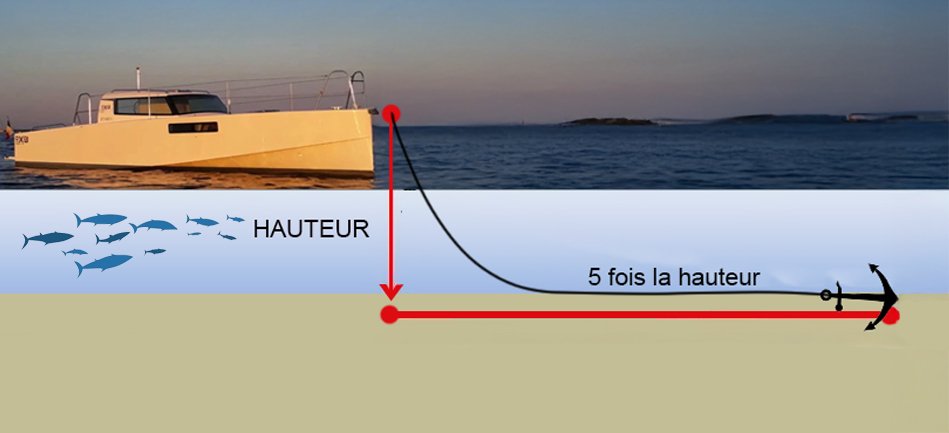
In normal conditions, the rule of thumb is to wet five times the total depth.
Example:
Depth: 6 m
Bow height: 1 m
Total height: 7 m
Recommended chain length : 7 × 5 = 35 metres
Adapt length to suit conditions
| Situation | Recommended ratio |
|---|---|
| Quick stop | 3 × |
| Normal anchorage | 5 × |
| Night at anchor | 7 × |
| Strong wind | 8 à 10 × |
These ratios ensure that the anchor retains an almost horizontal tension, which is essential if it is to hold.
A concrete example
Take a typical case in the Mediterranean.
Depth: 8 m
Bow height: 1 m
Total height: 9 m
Chain length required :
- Normal anchorage: 45 m
- Overnight at anchor: 63 m
- Strong wind: 72 m
With only 40 metres of chain, we're already at our limit in this type of situation.
Why this length is essential
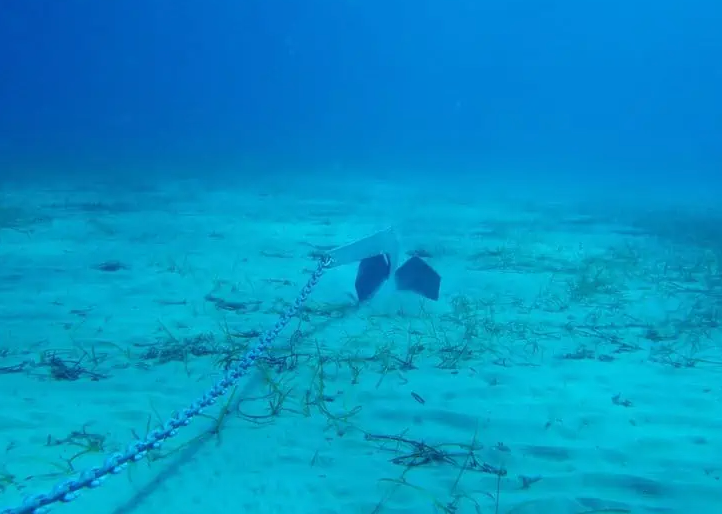
The chain naturally forms a curve called a catenary.
This curve plays an important role:
- It maintains horizontal traction on the anchor
- It absorbs the forces of wind and waves
- It prevents the anchor from unhooking
When the chain is too short, the pull becomes vertical. The anchor can then tear away from the bottom and the boat begins to drift.
This is the main cause of boats hunting at anchor.
Another simple rule
Some sailors also use a rule of thumb: the minimum length of chain must be at least as long as the boat.
For example: 12-metre boat → minimum 12 metres of chain.
This rule applied mainly to the old chain-and-rope combinations. Today, most cruising boats use an all-chain line.
Mooring dimensions according to boat size
These values correspond to current practice in the Mediterranean, based on the recommendations of anchor manufacturers and nautical guides.
| Boat length | Anchor weight | Channel | Chain length |
|---|---|---|---|
| 6 - 8 m | 8 - 10 kg | 6 mm | 40 - 50 m |
| 8 - 10 m | 10 - 15 kg | 6 - 8 mm | 50 - 60 m |
| 10 - 12 m | 15 - 20 kg | 8 mm | 60 - 80 m |
| 12 - 14 m | 20 - 25 kg | 8 - 10 mm | 80 - 100 m |
| 14 - 18 m | 25 - 35 kg | 10 mm | 100 m |
| 18 - 24 m | 40 - 60 kg | 12 mm | 100 - 120 m |
These values may vary depending on the boat's displacement, the sailing area and the type of anchor.
The simple rule for old sailors
When you don't want to get out the calculator, there's a fairly reliable rule of thumb: wet more chain than your neighbours.
Curiously, it's almost always the one with the most water chains that sleeps best at night.
Checking your mooring
Most GPS trackers now offer an anchor alarm.
The principle is simple: you define a safety radius around the anchoring point. If the boat leaves this zone, an alarm is triggered.
This tool is very useful at night or in a busy harbour.
But there's no substitute for a simple reflex: take a few visual cues from ashore to check that the boat isn't moving.
Mooring in port
Mooring works differently to anchoring.
In a harbour, the forces are transferred to fixed structures: quays, pontoons or moorings.
The mooring lines must therefore absorb :
- Wind variations
- Passing swell
- Movements of other boats
To achieve this, they need to combine strength and elasticity.
Bollards and their position
Bollards are the anchor points for the mooring lines on the boat.
They must be securely installed and correctly sized. Their position has a direct influence on the angle of the mooring lines and the distribution of forces.
A well-placed bitta means you can work at effective angles and spread loads over several lines.
It's an architectural detail that's often invisible, but essential.
Fenders
Fenders are the first line of protection between the hull and the quay.
The classic cylindrical models are still the most widely used because they absorb shocks effectively and are well suited to longer stopovers.
Inflatable or foldable models are easier to store, but are mainly used when storage space is limited.
Fender covers also reduce abrasion and protect the gelcoat.
Manoeuvring aids
Aids to manoeuvring have evolved considerably in recent years.
The bow thruster moves the bow of the boat sideways when manoeuvring in port. On larger boats, a stern thruster can be added to further improve control.
Some modern systems even allow you to manoeuvre with a joystick. Thanks to steerable transmissions, the boat can then move sideways, pivot on the spot and position itself with great precision.
These technologies considerably simplify manoeuvring, particularly in narrow harbours or in crosswind conditions.
In conclusion
A safe anchorage or reliable mooring never depends on a single piece of equipment. It is always the result of a coherent combination of equipment and good practice.
The right anchor, the right chain, the right windlass and a few simple habits can prevent most problems.
And at the end of the day, the aim is still the same: to spend a peaceful night at anchor... without waking up every hour to check if the boat is moving.
Back to topAncoraggio e ormeggio: le basi per dormire tranquilli in rada
When a boat is sailing, there is always a certain amount of anticipation. But when it's closed, everything must be perfectly under control.
A careless anchorage or a poorly prepared anchorage can turn a tranquil serata into an insane night spent checking the GPS... or pegging out, in a slow drift towards the next boat.
From RivieraBroker we often see very well-equipped boats, sometimes even of high quality, but with a male or used male anchor system. But there are a few simple rules to make the situation safer.
Here are the essential points to know.
Un buon ancoraggio è un equilibrio
Ancorare una barca non significa semplicemente buttare l'ancora in acqua.
Un ancoraggio efficace nasce sempre da un insieme coerente di elementi:
- L'ancora
- The catena
- La linea di ancoraggio
- Il verricello salpa ancora
- E naturalmente il modo in cui tutto questo viene usato
Se anche uno solo di questi elementi è sottodimensionato o non adatto alla barca, l'efficacia complessiva del sistema cala rapidamente. It is only in such cases that you will see a hose start to peel the bottom and then drift away.
Un buon ancoraggio è quindi, prima di tutto, un equilibrio tra attrezzatura e metodo.
Scegliere bene l'ancora
La scelta dell'ancora dipende soprattutto dal tipo di fondale su cui si ancora più spesso.
In the Mediterranean region, the most common types of soil are..:
- Sabbia
- Fango
- Praterie di posidonia
- Fondi misti sabbia e roccia
On sand or fango, anchors capable of penetrating well into the substrate offer excellent results. I modelli tipo aratro o pala restano soluzioni molto affidabili e diffusi.
Sui fondi misti, le ancore moderne con geometria auto-orientante sono spesso più efficaci. Riescono a riposizionarsi rapidamente quando la direzione del tiro cambia per effetto del vento o della corrente.
Over the last few decades, a number of new-generation models have become established. The concave shape of these models makes them easy to handle and very stable, even when the boat is moving around the anchoring point.
Sono ancore più costose, ma per una barca che passa tempo in rada, l'investimento è in genere ben giustificato.
Il salpa ancora: uno strumento, non un verricello di trazione
Salt is still a fundamental element, but it is often used incorrectly.
Its task is simply to clean and recover the anchor line. It is not designed to pull a boat of different sizes towards its own anchor line.
La pratica corretta consiste nel lasciare scendere l'ancora per gravità, controllando la catena con la frizione del verricello. In this way, unnecessary strain on the motor and mechanical system is avoided.
Durante il recupero, invece, bisogna sempre avanzare lentamente verso l'ancora con la barca. Il salpa ancora deve limitarsi a recuperare la catena.
Può sembrare un dettaglio, ma incide molto sulla durata dell'impianto.
La catena: un elemento spesso sottovalutato
La catena svolge due funzioni essenziali:
- Dà peso alla linea di ancoraggio
- Mantiene l'ancora con il giusto angolo di trazione
On most crocodile bars, the most common diameters are 8 mm, 10 mm and 12 mm.
La scelta dipende soprattutto dalla dimensione e dal dislocamento della barca.
Una catena più pesante migliora il comportamento dell'ancoraggio, soprattutto quando il mare si forma o il vento aumenta.
Zinc-plated catenes are still the most widely used because they offer a good compromise between cost and durability. Stainless steel catene is more resistant to corrosion and more beautiful to look at, but the cost is much higher.
In ogni caso, è importante controllare regolarmente lo stato delle maglie, soprattutto vicino all'ancora dove gli sfregamenti sono più intensi.
Un dettaglio spesso dimenticato
Una volta che l'ancora è posata e la catena è filata, il carico non deve mai restare sul salpa ancora.
La tensione va trasferita su una bitta con l'aiuto di una cima o di un gancio di ancoraggio. Il salpa ancora deve lavorare soltanto nelle fasi di calata e recupero.
It's a simple detail, but it avoids unnecessary wear and tear and enhances the life of the material.
Lunghezza della catena da avere a bordo
Bisogna distinguere tra due cose:
- La lunghezza totale di catena a bordo
- La lunghezza realmente filata in acqua
Non sono la stessa cosa.
Per una barca da crociera, le raccomandazioni generali indicano una lunghezza totale compresa tra 70 e 120 metri, a seconda della dimensione della barca e della zona di navigazione.
In the Mediterranean, barges between 10 and 15 metres high have often been used:
- Da 50 a 80 metri di catena
- Talvolta 100 metri sulle unità che ancorano spesso
Può sembrare tanto, ma in molte rade si ancora facilmente su 15 o 20 metri d'acqua. Serve quindi abbastanza catena per mantenere il giusto angolo di tiro sull'ancora.
La regola fondamentale: rapporto profondità / catena
La lunghezza di catena da filare dipende dalla profondità totale.
Bisogna sempre considerare: profondità dell'acqua + altezza della prua.
Il rapporto tra questa altezza totale e la lunghezza di catena si chiama scope.
In normal conditions, the basic rule is to filter five times the total depth.
Esempio:
Depth: 6 m
Altezza della prua: 1 m
Total height: 7 m
Lunghezza di catena consigliata: 7 × 5 = 35 metri
Adattare la lunghezza alle condizioni
| Situazione | Rapporto consigliato |
|---|---|
| Sosta breve | 3 × |
| Ancoraggio normale | 5 × |
| Notte in rada | 7 × |
| Vento forte | 8 a 10 × |
Questi rapporti permettono di mantenere una trazione quasi orizzontale sull'ancora, condizione indispensabile per garantire la tenuta.
Concrete example
Let's take a typical case in the Mediterranean.
Depth: 8 m
Altezza della prua: 1 m
Total height: 9 m
Lunghezza di catena necessaria:
- Ancoraggio normale: 45 m
- Notte in rada: 63 m
- Vento forte: 72 m
With just 40 metres of catenary, we're already at the limit in this kind of situation.
Perché questa lunghezza è indispensabile
La catena forma naturalmente una curva chiamata catenaria.
This curve has an important role:
- Mantiene la trazione orizzontale sull'ancora
- Assorbe gli sforzi del vento e della risacca
- Evita che l'ancora si sganci
When the catena is too short, the drag becomes vertical. L'ancora può allora strappare il fondale e la barca comincia a derivare.
È la causa principale delle barche che arano in rada.
Un'altra regola semplice
Alcuni navigatori usano anche una regola empirica: la lunghezza minima di catena dovrebbe essere almeno pari alla lunghezza della barca.
Per esempio: barca di 12 metri → almeno 12 metri di catena.
Questa regola riguardava soprattutto i vecchi montaggi con catena e cima. Today, the majority of crocodile bars use a line interamente in catena.
Dimensionamento del sistema di ancoraggio in base alla dimensione della barca
These values correspond to the most common practices in the Mediterranean.
| Lunghezza barca | Peso ancora | Catena | Lunghezza catena |
|---|---|---|---|
| 6 - 8 m | 8 - 10 kg | 6 mm | 40 - 50 m |
| 8 - 10 m | 10 - 15 kg | 6 - 8 mm | 50 - 60 m |
| 10 - 12 m | 15 - 20 kg | 8 mm | 60 - 80 m |
| 12 - 14 m | 20 - 25 kg | 8 - 10 mm | 80 - 100 m |
| 14 - 18 m | 25 - 35 kg | 10 mm | 100 m |
| 18 - 24 m | 40 - 60 kg | 12 mm | 100 - 120 m |
Questi valori possono variare a seconda del dislocamento della barca, della zona di navigazione e del tipo di ancora.
La regola semplice dei vecchi marinai
Quando non si ha voglia di fare calcoli, esiste una regola empirica abbastanza affidabile: filare più catena dei vicini.
Curiosamente, è quasi sempre chi ha più catena in acqua che dorme meglio la notte.
Controllare il proprio ancoraggio
Oggi la maggior parte dei plotter GPS propone un allarme di ancoraggio.
The principle is simple: a safety distance from the anchoring point is defined. If the boat leaves this zone, an alarm sounds.
È uno strumento molto utile di notte o in una rada affollata.
Ma niente sostituisce un riflesso semplice: prendere alcuni riferimenti visivi a terra per verificare che la barca non si sposti.
L'ormeggio in porto
L'ormeggio segue una logica diversa rispetto all'ancoraggio.
In port, sforzi vengono trasferiti verso strutture fisse: banchina, pontile o corpo morto.
Le cime di ormeggio devono quindi assorbire:
- Wind variations
- La risacca di passaggio
- I movimenti delle altre imbarcazioni
For this reason, they must combine strength and elasticity.
Bitte e la loro posizione
Le bitte sono i punti di fissaggio delle cime sulla barca.
Devono essere solidamente installate e correttamente dimensionate. La loro posizione influenza direttamente sull'angolo delle cime e sulla ripartizione degli sforzi.
Una bitta ben posizionata permette di lavorare con angoli corretti e di distribuire il carico su più linee.
È un dettaglio spesso invisibile, ma essenziale.
I parabordi
I parabordi costituiscono la prima protezione tra lo scafo e la banchina.
I modelli cilindrici classici restano i più usati perché assorbono bene gli urti e sono adatti alle soste prolungate.
I modelli gonfiabili o pieghevoli si stivano più facilmente, ma vengono usati soprattutto quando lo spazio è limitato.
Le calze copriparabordo aiutano inoltre a ridurre l'abrasione e a proteggere il gelcoat.
Gli aiuti alla manovra
Negli ultimi anni gli aiuti alla manovra si sono evoluti molto.
The bow thruster allows the prua to be positioned laterally when manoeuvring in port. On larger rods you can also add a poppa thruster to increase control.
Some modern systems allow you to manoeuvre with a joystick. Grazie a trasmissioni orientabili, la barca può spostarsi lateralmente, ruotare su sé stessa e posizionarsi con grande precisione.
Queste tecnologie semplificano molto le manovre, soprattutto nei porti stretti o con vento al traverso.
Conclusione
Un ancoraggio sicuro o un ormeggio affidabile non dipendono mai da un solo componente. Sono sempre il risultato di un insieme coerente tra attrezzatura e buone pratiche.
Un'ancora adatta, una catena ben dimensionata, un salpa ancora usato correttamente e alcune abitudini semplici permettono di evitare la maggiorte parte dei problemi.
E alla fine l'obiettivo è sempre lo stesso: passare una notte tranquilla in rada, senza svegliarsi ogna per controllare se la barca si è spostata.
Torna in altoAnchoring and mooring: the essentials for sleeping well at anchor
When a boat is underway, a certain amount of unpredictability is part of the game. But when the boat is stationary, everything needs to be properly under control.
A poor anchoring setup or a badly prepared mooring can turn a quiet evening into a sleepless night spent watching the GPS... or worse, into a slow drift towards the next boat.
At RivieraBroker, we regularly see boats that are very well equipped, sometimes even high-end, but fitted with anchoring systems that are poorly chosen or poorly used. In reality, a few simple rules are often enough to make things much safer.
Here are the key points to understand.
Good anchoring is all about balance
Anchoring a boat is not just a matter of throwing the anchor overboard.
An effective anchoring setup always relies on a coherent combination of elements:
- The anchor
- The chain
- The anchoring line
- The windlass
- And, of course, the way all of it is used
If just one of these elements is undersized or not suited to the boat, the efficiency of the whole system drops quickly. That is usually when a boat starts slowly ploughing the seabed before drifting away.
Good anchoring is therefore above all a proper balance between equipment and technique.
Choosing the right anchor
The choice of anchor depends mainly on the type of seabed where the boat is anchored most often.
In the Mediterranean, the most common seabeds are:
- Sand
- Mud
- Posidonia seagrass
- Mixed sand and rock bottoms
On sand or mud, anchors that dig in deeply usually perform very well. Plough-type and scoop-type anchors remain proven and widely used solutions.
On mixed bottoms, modern self-righting anchors are often more effective. They can reset quickly when the direction of pull changes because of wind or current.
Over the past fifteen years, several new-generation models have become very popular. Their concave shape helps them set quickly and hold very firmly, even when the boat swings around its anchor.
These anchors are more expensive, but for a boat that spends time at anchor, the investment is generally worthwhile.
The windlass: a tool, not a towing winch
The windlass is an essential piece of equipment, but it is often used incorrectly.
Its role is simply to lower and retrieve the anchoring line. It is not designed to drag several tonnes of boat toward the anchor.
The correct method is to let the anchor go down by gravity while controlling the chain with the windlass clutch. This avoids unnecessary strain on the motor and the gearbox.
When retrieving, the boat should always move slowly toward the anchor. The windlass should only be recovering the chain.
It may sound obvious, but this detail makes a real difference to the service life of the equipment.
The chain: often underestimated
The chain has two essential functions:
- It adds weight to the anchoring line
- It keeps the anchor at the correct angle of pull
On most cruising boats, the most common chain diameters are 8 mm, 10 mm and 12 mm.
The correct size depends mainly on the size and displacement of the boat.
A heavier chain improves anchoring behaviour, especially when the sea builds up or the wind increases.
Galvanized chains remain the most common because they offer a good balance between price and durability. Stainless steel chains resist corrosion better and look smarter, but they are significantly more expensive.
In all cases, the links should be checked regularly, especially close to the anchor where wear is greatest.
A detail that is often forgotten
Once the anchor is set and the chain has been paid out, the load should never remain on the windlass.
The tension should be transferred to a cleat using a line or an anchor snubber. The windlass should only work during lowering and retrieval.
It is a simple detail, but it prevents unnecessary wear and helps the equipment last longer.
How much chain to carry on board
Two things need to be clearly distinguished:
- The total amount of chain carried on board
- The actual amount of chain paid out into the water
These are not the same thing.
For a cruising boat, general recommendations place the total chain length somewhere between 70 and 120 metres, depending on boat size and cruising area.
In the Mediterranean, boats between 10 and 15 metres often carry:
- 50 to 80 metres of chain
- Sometimes 100 metres on boats that anchor frequently
This may sound like a lot, but many anchorages are easily 15 to 20 metres deep. Sufficient chain is therefore needed to keep the anchor working at the right angle.
The essential rule: depth-to-chain ratio
The amount of chain to pay out depends on the total depth.
You must always take into account: water depth + bow height above the water.
The ratio between this total height and the chain length is called the scope.
In normal conditions, the basic rule is to pay out five times the total depth.
Example:
Depth: 6 m
Bow height: 1 m
Total height: 7 m
Recommended chain length: 7 × 5 = 35 metres
Adjusting the length to the conditions
| Situation | Recommended ratio |
|---|---|
| Short stop | 3 × |
| Normal anchoring | 5 × |
| Overnight anchoring | 7 × |
| Strong wind | 8 to 10 × |
These ratios help maintain an almost horizontal pull on the anchor, which is essential for reliable holding.
A practical example
Let's take a typical Mediterranean case.
Depth: 8 m
Bow height: 1 m
Total height: 9 m
Required chain length:
- Normal anchoring: 45 m
- Overnight anchoring: 63 m
- Strong wind: 72 m
With only 40 metres of chain, you are already on the limit in that kind of situation.
Why this length matters
The chain naturally forms a curve known as a catenary.
This curve plays an important role:
- It keeps the pull on the anchor horizontal
- It absorbs loads caused by wind and wave action
- It helps prevent the anchor from breaking out
If the chain is too short, the pull becomes vertical. The anchor may then break free from the seabed and the boat starts to drift.
This is the main reason why boats drag at anchor.
Another simple rule
Some sailors also use a rough rule of thumb: the minimum chain length should be at least equal to the length of the boat.
For example: 12-metre boat → at least 12 metres of chain.
This rule mostly came from older chain-and-rope setups. Today, most cruising boats use an all-chain anchoring line.
Anchoring setup by boat size
These values reflect common Mediterranean practice.
| Boat length | Anchor weight | Chain | Chain length |
|---|---|---|---|
| 6 - 8 m | 8 - 10 kg | 6 mm | 40 - 50 m |
| 8 - 10 m | 10 - 15 kg | 6 - 8 mm | 50 - 60 m |
| 10 - 12 m | 15 - 20 kg | 8 mm | 60 - 80 m |
| 12 - 14 m | 20 - 25 kg | 8 - 10 mm | 80 - 100 m |
| 14 - 18 m | 25 - 35 kg | 10 mm | 100 m |
| 18 - 24 m | 40 - 60 kg | 12 mm | 100 - 120 m |
These values may vary depending on displacement, cruising area and anchor type.
The old sailor's rule
If you don't want to start calculating, there is a rough rule that is often surprisingly reliable: pay out more chain than the boats around you.
Strangely enough, the boat with the most chain in the water is usually the one whose crew sleeps best at night.
Monitoring your anchorage
Most modern GPS plotters now include an anchor alarm.
The principle is simple: you set a safety radius around the anchor position. If the boat moves outside that area, the alarm goes off.
It is a very useful feature at night or in a crowded anchorage.
Still, nothing replaces a simple habit: taking a few visual bearings ashore to make sure the boat is not moving.
Mooring in port
Mooring follows a different logic from anchoring.
In port, the loads are transferred to fixed structures such as a quay, pontoon or mooring block.
Mooring lines therefore need to absorb:
- Changes in wind
- Passing wash or surge
- The movement of nearby boats
To do that properly, they need both strength and elasticity.
Cleats and their position
Cleats are the fixing points for mooring lines on the boat.
They need to be properly installed and correctly sized. Their position has a direct effect on line angles and load distribution.
A well-positioned cleat allows the loads to be spread across several lines with better working angles.
It is often an invisible design detail, but it is essential.
Fenders
Fenders are the first line of protection between the hull and the quay.
Classic cylindrical fenders remain the most widely used because they absorb impacts well and are perfectly suited to longer stays alongside.
Inflatable or foldable models are easier to store, but they are mostly used where storage space is limited.
Fender covers also help reduce abrasion and protect the gelcoat.
Manoeuvring aids
Manoeuvring aids have evolved a lot in recent years.
A bow thruster allows the bow to move sideways during harbour manoeuvres. On larger boats, a stern thruster can be added for even better control.
Some modern systems even allow the boat to be manoeuvred with a joystick. Thanks to steerable drives, the boat can move sideways, spin on the spot and position itself with impressive precision.
These technologies make harbour manoeuvres much easier, especially in tight spaces or with a crosswind.
Conclusion
Safe anchoring or reliable mooring never depends on a single piece of equipment. It is always the result of a coherent combination of gear and good practice.
A suitable anchor, properly sized chain, correct windlass use and a few simple habits will prevent most problems.
And in the end, the goal is always the same: a quiet night at anchor without waking up every hour to check whether the boat has moved.
Back to top